
The bodybuilding and fitness supplement market is booming. With more people prioritizing fitness and performance optimization, the demand for high-quality pre-workout formulas, post-workout recovery products, and specialized bodybuilding supplements continues to climb.
If you’re thinking about launching your own brand of workout or bodybuilding supplements, you’re entering a market worth billions, but also one where quality, formulation, and brand trust separate winners from the products that never make it past a first run.
The difference between a successful launch and a costly failure often comes down to choosing the right bodybuilding supplement manufacturer. The manufacturer you partner with determines your product quality, compliance, production timelines, and ultimately, your brand reputation.
This guide walks you through everything you need to know about bodybuilding supplement manufacturing, from understanding how production works to vetting manufacturers, navigating MOQs, and scaling your brand once you’ve gained traction.
How Bodybuilding Supplement Manufacturing Works (Step-by-Step)
Bodybuilding supplement manufacturing involves several distinct stages, each important to producing safe, effective products that meet regulatory requirements. The entire process can take anywhere from 6 to 16 weeks, depending on product complexity and manufacturer capacity.
1. Formulation & Development
The process starts with formulation development. This stage involves R&D support to optimize the product for performance, taste, and shelf stability.
- Key Decisions: Choosing ingredients, determining dosages, and ensuring the final formula is stable and effective.
2. Ingredient Sourcing & Vetting
Quality manufacturers maintain relationships with verified suppliers to ensure purity and potency.
- Quality Checks: Raw materials undergo identity testing and contamination screening before approval for production.
3. Manufacturing & Production
The actual manufacturing process varies based on the product format:
- Powders: Blended using specialized equipment to ensure uniform distribution of all ingredients.
- Capsules & Tablets: Require encapsulation or compression machinery.
- Liquid Supplements: Involve precise mixing, filtering, and bottling processes.
4. Quality Control & Testing
Throughout and after production, quality control checkpoints verify that products meet specifications.
- In-Process Checks: Includes in-process testing, weight checks, and visual inspections.
- Final Testing: Finished products undergo final testing for potency, purity, and microbial contamination before receiving approval for distribution.
5. Packaging & Labeling
The product is prepared for retail sale with compliant information.
- Retail Readiness: Products are prepared with compliant labels, lot codes, and expiration dates required for distribution.
Expert Pre-Workout Flavoring & Stimulants
Success in pre-workout supplement manufacturing relies on balancing high-performance stimulants with superior taste profiles. We utilize advanced flavor-masking technology to neutralize the bitterness of active ingredients like citrulline and beta-alanine, ensuring your product dissolves perfectly and tastes exceptional. Whether your brand targets clean-label, natural energy or intense, high-caffeine formulas, our R&D teams provide precision dosing to prevent post-workout crashes while maximizing focus and endurance.
Our facility offers both stimulant-heavy and stim-free options to meet diverse market demands, including trending nootropic and plant-based configurations. By integrating proven compounds like caffeine anhydrous or slow-release variants at clinically effective dosages, we help you build consumer trust and brand loyalty. From custom flavoring to strict potency testing, we ensure every batch meets your exact specifications for performance and palatability.

Choosing a Reliable Bodybuilding Supplement Manufacturer
Not all bodybuilding supplement manufacturers are alike. The right partner brings expertise, quality systems, and reliability that protect your brand.
1. Compliance and Quality Assurance
Start by verifying their credentials, as these protect your brand and consumers.
Verify GMP/FDA: Any legitimate USA manufacturer must comply with Good Manufacturing Practices (GMP) outlined in 21 CFR Part 111 and maintain FDA registration. Ask to see documentation.
Third-Party Vetting: Request client references and facility tours to gain unfiltered insight into their reliability and quality systems.
2. Category Expertise and Experience
Choose a partner who understands the fitness market’s unique demands.
Sports Nutrition Specialization: Manufacturers who specialize in sports nutrition understand unique formulation challenges, ingredient trends, and customer expectations.
Formulation Insight: They can offer valuable insights about what’s working in the market and help you avoid common formulation pitfalls.
3. Production Capabilities & Alignment
Ensure the manufacturer’s equipment matches your product needs.
Powders: Verify appropriate blending equipment and flavor masking expertise for pre-workouts.
Capsules: Verify encapsulation capacity and ability to handle specialty options (e.g., delayed-release or vegetarian capsules).
4. Communication and Service
Communication quality is a strong predictor of a successful partnership.
Vetting Process: Take note of how quickly they respond, how clearly they explain processes, and whether they proactively address your concerns. A manufacturer who’s hard to reach during the sales process will be even harder to work with during production.
RELATED READ:
How To Find Low MOQ Supplement Manufacturer for SMEs – Comprehensive Guide
Top Workout Supplement Manufacturers to Consider
When evaluating workout supplement manufacturers, you’ll find options ranging from large-scale operations serving major brands to boutique manufacturers specializing in custom formulations for emerging companies.
Large manufacturers typically offer the most competitive pricing at high volumes, established quality systems, and extensive capabilities across multiple product formats. However, they often have higher minimum order quantities and may provide less personalized attention to smaller brands.
Mid-size manufacturers strike a balance between capacity and flexibility. They can usually accommodate moderate production runs while still offering formulation support and reasonable lead times. These manufacturers often have experience working with both established brands and startups.
Specialty manufacturers focus on specific niches within sports nutrition. Some specialize exclusively in powdered supplements, while others excel at capsule or ready-to-drink formulations. If you have a clear vision for your product format, a specialist manufacturer might deliver superior results.
The best approach is creating a shortlist of 3-5 manufacturers who meet your basic needs, then diving deeper into their specific capabilities, pricing, and fit with your brand values. Don’t rush this decision, because your manufacturing partner significantly impacts your long-term success.
Pre-Workout Supplement Manufacturers Overview
Pre-workout supplements present unique manufacturing challenges that not all facilities are equipped to handle effectively.
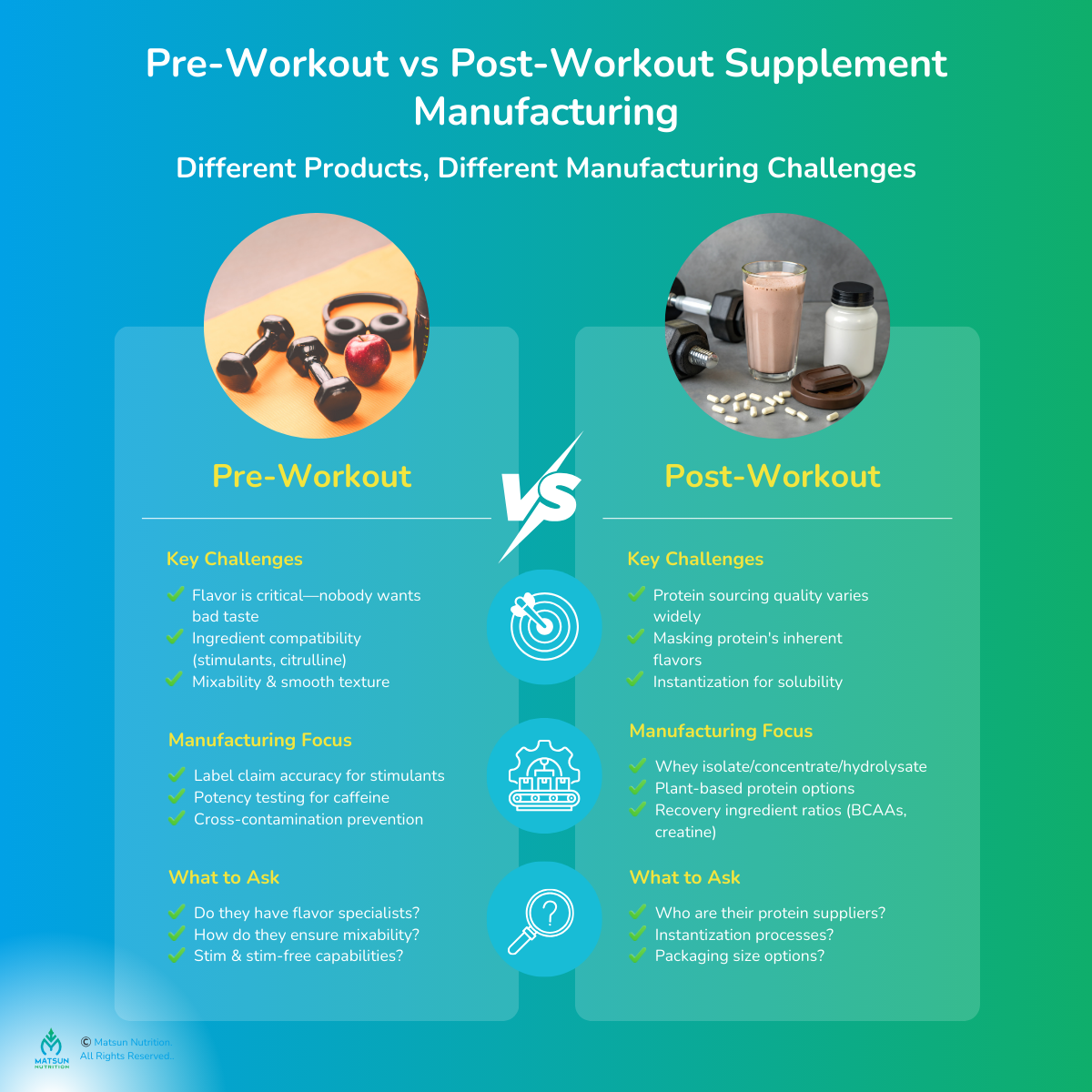
Flavor is critical in pre-workout formulas. Nobody wants to choke down a terrible-tasting powder before hitting the gym, regardless of how effective the ingredients are. When evaluating pre-workout supplement manufacturers, ask about their flavor development capabilities and whether they employ food scientists or flavor specialists.
Ingredient compatibility matters more in pre-workouts than almost any other supplement category. Many popular pre-workout ingredients, like citrulline, beta-alanine, and various stimulants, can interact or degrade if not formulated properly. Experienced manufacturers understand these challenges and can formulate around potential stability issues.
Mixability and texture impact user experience. Pre-workout powders should dissolve easily without clumping or leaving gritty residue. This requires proper particle size selection and sometimes the addition of flow agents or anti-caking ingredients. Ask manufacturers how they ensure optimal mixability.
Label claim accuracy is especially important for pre-workouts since many contain stimulants with specific dosage requirements. Your manufacturer should conduct potency testing to verify that caffeine and other active ingredients match label claims within acceptable ranges.
Finally, consider whether the manufacturer can produce both stimulant and stimulant-free versions if you plan to offer multiple options. Some facilities have protocols for preventing cross-contamination between caffeinated and caffeine-free products.
Post-Workout Supplement Manufacturers Insights
Post-workout supplements focus on recovery, and their manufacturing requirements differ significantly from pre-workout formulas.
Protein is the cornerstone of most post-workout products, and protein sourcing quality varies widely. When vetting post-workout supplement manufacturers, ask about their protein suppliers. Do they use high-quality whey isolate, concentrate, or hydrolysate? Can they source plant-based proteins like pea, rice, or hemp? What about protein blends?
Flavor challenges exist here too, but they’re different from pre-workouts. Protein powders can have inherent flavors that are difficult to mask, particularly plant-based proteins. Manufacturers with strong flavor systems can create post-workout formulas that taste great while delivering effective recovery ingredients.
Instantization affects how well protein powders mix. Quality manufacturers use instantizing processes that improve solubility and reduce foam. This might seem like a minor detail, but it significantly impacts customer satisfaction and repeat purchases.
Additional recovery ingredients like BCAAs, glutamine, creatine, and carbohydrates need to be compatible with the protein source and properly dosed. Experienced post-workout manufacturers understand proper ratios and can formulate complete recovery formulas that work synergistically.
Packaging considerations matter for post-workout products since they’re often sold in larger containers than pre-workouts. Ask about packaging options, whether they can accommodate various sizes, and if they handle fulfillment services for direct-to-consumer brands.
Key Steps for Formulating Bodybuilding Supplements
Whether you’re working with a manufacturer’s existing formulas or developing something custom, understanding the formulation process helps you make informed decisions.
1. Define Product Goals
What benefits do you want to deliver (e.g., endurance, muscle gain)?
Who is your target customer (e.g., active lifestyle, competitive athlete)?
What price point are you aiming for?
These answers guide ingredient selection and dosing decisions.
2. Research Ingredients & Trends
Proven Staples: Focus on ingredients known to work, such as creatine monohydrate, whey protein, and beta-alanine.
Trending Compounds: Research new ingredients, but ensure they are backed by science before inclusion.
Research trending ingredients and backed-by-science compounds. The bodybuilding supplement market moves quickly, with new ingredients gaining popularity regularly. However, proven ingredients like creatine monohydrate, whey protein, and beta-alanine remain staples because they work.
3. Select Appropriate Dosages
Manufacturer Support: Work with your manufacturer to select proper dosing based on research to ensure customers get real results.
Underdosing popular ingredients to save costs creates ineffective products that damage your reputation. Proper dosing based on research ensures customers get real results.
4. Consider Sensory Attributes Early in Development
Taste: How should the product taste, and is flavor masking needed?
Texture: What texture are you targeting (e.g., smooth mixability, no grit)?
Color: What color appeals to your demographic?
These factors influence customer satisfaction as much as efficacy does.
5. Plan for Stability Testing
Shelf Life: Manufacturers should conduct accelerated stability studies to predict how products will perform over time and establish appropriate expiration dates.
Your formula needs to maintain potency and quality throughout its shelf life. Manufacturers should conduct accelerated stability studies to predict how products will perform over time and establish appropriate expiration dates.
6. Ensure Regulatory Compliance
FDA Compliance: Your formulation must comply with FDA regulations regarding ingredient approvals, dosage limits, and structure/function claims. Experienced manufacturers help navigate these requirements.

Ensuring Quality and Compliance in Manufacturing
Quality and compliance are fundamental to staying in business and protecting consumers.
Good Manufacturing Practices (GMP) provide the framework for quality supplement production. These regulations cover everything from facility design to employee training to record keeping. Your manufacturer should have documented procedures for every aspect of production and quality control.
Testing protocols should be comprehensive and consistent. At minimum, expect testing of raw materials for identity, purity, and potency, plus finished product testing for label claim verification, microbial contamination, and heavy metals. Many manufacturers also test for banned substances, which is particularly important in sports nutrition.
Documentation creates accountability. Your manufacturer should provide Certificates of Analysis (COAs) for every batch, batch production records, and stability data. You will need this documentation if you ever face regulatory scrutiny or customer complaints.
Traceability systems allow tracking from raw materials through finished products. If a quality issue arises, robust traceability helps identify the source quickly and determine which batches are affected.
Third-party certifications add credibility. While GMP compliance is mandatory, additional certifications from organizations like NSF International, Informed-Sport, or BSCG demonstrate extra commitment to quality and banned substance testing.
Never compromise on quality to save costs. Cutting corners might reduce your upfront investment, but quality issues destroy brands faster than almost anything else.
Production Capacity and Lead Times Explained
Understanding production timelines helps you plan inventory, manage cash flow, and meet customer demand without stockouts.
Standard lead times for bodybuilding supplements typically range from 8 to 12 weeks from order placement to delivery. This includes raw material procurement (2-4 weeks), production (1-2 weeks), testing (1-2 weeks), and packaging (1-2 weeks).
However, custom formulations add time. If you’re developing a new formula, expect an additional 4-8 weeks for formulation development, pilot batches, and stability initiation. Rush timelines are sometimes available for premium fees, but proper planning is more cost-effective.
Production capacity affects your ability to scale. During your manufacturer evaluation, ask about their capacity limits. Can they handle your current order size and your projected growth? What’s their lead time when operating at capacity versus during slower periods?
Ingredient availability can extend timelines. Some specialty ingredients have longer lead times or limited availability. Manufacturers with strong supplier relationships often have better access to in-demand ingredients.
Seasonal demand spikes impact scheduling, especially in fitness supplements where January and summer months see increased sales. Book production runs well in advance during peak seasons.
Building buffer inventory prevents stockouts but ties up capital. Work with your manufacturer to find the right balance based on your sales velocity and their production flexibility.
MOQ and Costs for Workout Supplement Lines
Minimum order quantities and pricing structure significantly impact your launch budget and cash flow requirements.
MOQs vary widely between bodybuilding supplement manufacturers. Some require minimums of 10,000+ units for powder products, while others work with startups at 500-1,000 unit minimums. Higher MOQs typically come with better per-unit pricing but require larger upfront investments.
Product format affects minimums. Powdered supplements often have lower MOQs than capsules because setup costs are different. Ready-to-drink products typically have the highest minimums due to equipment setup and packaging requirements.
Pricing includes multiple components beyond just the product itself. Expect costs for formulation development, raw materials, manufacturing labor, packaging components, testing, and sometimes warehousing. Get detailed quotes that break down all expenses to avoid surprises.
Volume discounts reward larger orders. Most manufacturers offer tiered pricing where per-unit costs decrease as order size increases. Understanding these break points helps you optimize order quantities for best value.
Custom packaging increases costs but strengthens branding. Stock packaging is cheaper but less differentiated. Decide which approach makes sense for your launch phase and long-term brand strategy.
Payment terms affect cash flow. Some manufacturers require full payment upfront, while others offer terms like 50% deposit with balance due before shipping. Negotiate terms that work for your business model.
RELATED READ:
Scaling Your Supplement Brand After Launch
Getting your first production run to market is exciting, but sustainable growth requires strategic scaling.
Strategic Growth & Inventory
- Monitor Sales Velocity: Closely track how quickly products move. This helps you time reorders appropriately. Running out of stock costs you sales and momentum, while overordering ties up capital.
- Buffer Inventory: Work with your manufacturer to find the right balance between preventing stockouts and tying up capital.
- Optimize Your Formula: Listen to customer feedback (reviews) and work with your manufacturer to refine formulas for better taste, mixability, or efficacy in subsequent runs.
- Strategic Line Expansion: Start with your hero product and add complementary items (like post-workout if your pre-workout is successful) as you gain traction. Focus on quality over quantity.
Leveraging Your Manufacturer Partnership
- Negotiate Better Terms: Once you have an established track record, negotiate lower MOQs, better pricing, or more favorable payment terms.
Build the Relationship: Treat your manufacturer as a partner, not just a vendor. This leads to collaboration, priority scheduling, and shared success.
Ready to Launch Your Brand?
Ready to launch your bodybuilding supplement line with a manufacturing partner who understands the fitness industry inside and out?
At Matsun Nutrition, we specialize in bodybuilding and workout supplement manufacturing with the quality systems, formulation expertise, and scalability you need for success.
Get a custom quote tailored to your vision, or explore our shop to see the quality we deliver every day. Let’s build your brand together.
Frequently Asked Questions
How do I select the best supplement manufacturer?
Evaluate manufacturers based on GMP certification, category expertise, production capabilities, communication quality, and client references. Request facility tours when possible and verify all certifications independently. The best manufacturer aligns with your product needs, budget, and growth plans while maintaining transparent communication throughout the process.
What makes a top bodybuilding supplement manufacturer?
Top manufacturers combine regulatory compliance, specialized equipment for sports nutrition products, formulation expertise in performance ingredients, rigorous quality testing, and experience working with fitness brands. They understand bodybuilding supplement trends, can optimize formulas for taste and efficacy, and have systems for ensuring consistent product quality batch after batch.
How to vet pre-workout supplement manufacturers?
Ask about their flavor development capabilities, experience with stimulant formulations, mixability optimization processes, and potency testing protocols. Request samples of similar products they’ve manufactured and ask how they handle ingredient compatibility issues common in pre-workout formulas. Verify they can meet label claim accuracy requirements for caffeine and other active ingredients.
What questions to ask post-workout supplement makers?
Focus on their protein sourcing quality, instantization capabilities, experience with recovery formulations, and ability to handle various protein types (whey, plant-based, blends). Ask about their testing for protein content verification, how they manage flavor challenges with different protein sources, and what packaging options they offer for post-workout products.
How long does supplement manufacturing take?
Standard production runs typically take 8-12 weeks from order to delivery, including raw material procurement, manufacturing, testing, and packaging. Custom formulation development adds 4-8 weeks. Rush production is sometimes available for additional fees. Lead times vary based on manufacturer capacity, ingredient availability, and product complexity.
What is the MOQ for bodybuilding supplement orders?
MOQs vary significantly in the industry, often ranging up to 10,000+ units for large-scale operations. Matsun Nutrition specializes in supporting startups and growth-stage brands, offering flexible minimum order quantities (MOQs) starting as low as 2,500 units for powdered supplements. This Low MOQ approach significantly reduces your upfront investment and market risk. We encourage you to clarify MOQs for your specific formula during initial conversations.
How do workout supplement manufacturers ensure quality?
Quality manufacturers follow GMP regulations with comprehensive testing protocols including raw material identity and purity verification, in-process quality checks, and finished product testing for potency, microbial contamination, and heavy metals. They maintain detailed documentation, conduct stability studies, and many pursue third-party certifications like NSF or Informed-Sport for additional verification.
Can supplement lines scale with low MOQ manufacturers?
Yes, many manufacturers accommodate growth by offering flexible MOQs at different pricing tiers. Start with lower minimums during launch, then increase order sizes as sales grow to access better per-unit pricing. Choose manufacturers who can handle both your current volume and projected growth to avoid switching partners as you scale.