If you have a vision for a health and wellness brand, the price tag of launching can feel overwhelming. Between formulation, packaging, compliance, and inventory, it can seem like you need deep pockets just to get started. That’s not always true. In fact, building a line of private label health supplements is one of the most accessible paths into the supplement industry, and you can absolutely do it on a budget if you know where to focus your dollars.
We’ll break down the real costs, the smartest shortcuts, and the strategies that successful founders use to launch without draining their savings accounts.
Understanding Startup Costs for Private Label Health Supplements
Before you commit a single dollar, it helps to understand what you’re actually paying for when you start a startup supplement business. The major cost buckets include product manufacturing, label and packaging design, regulatory compliance, and initial inventory. The total startup supplement business costs depend on product type, order size, and how much branding work you do yourself.
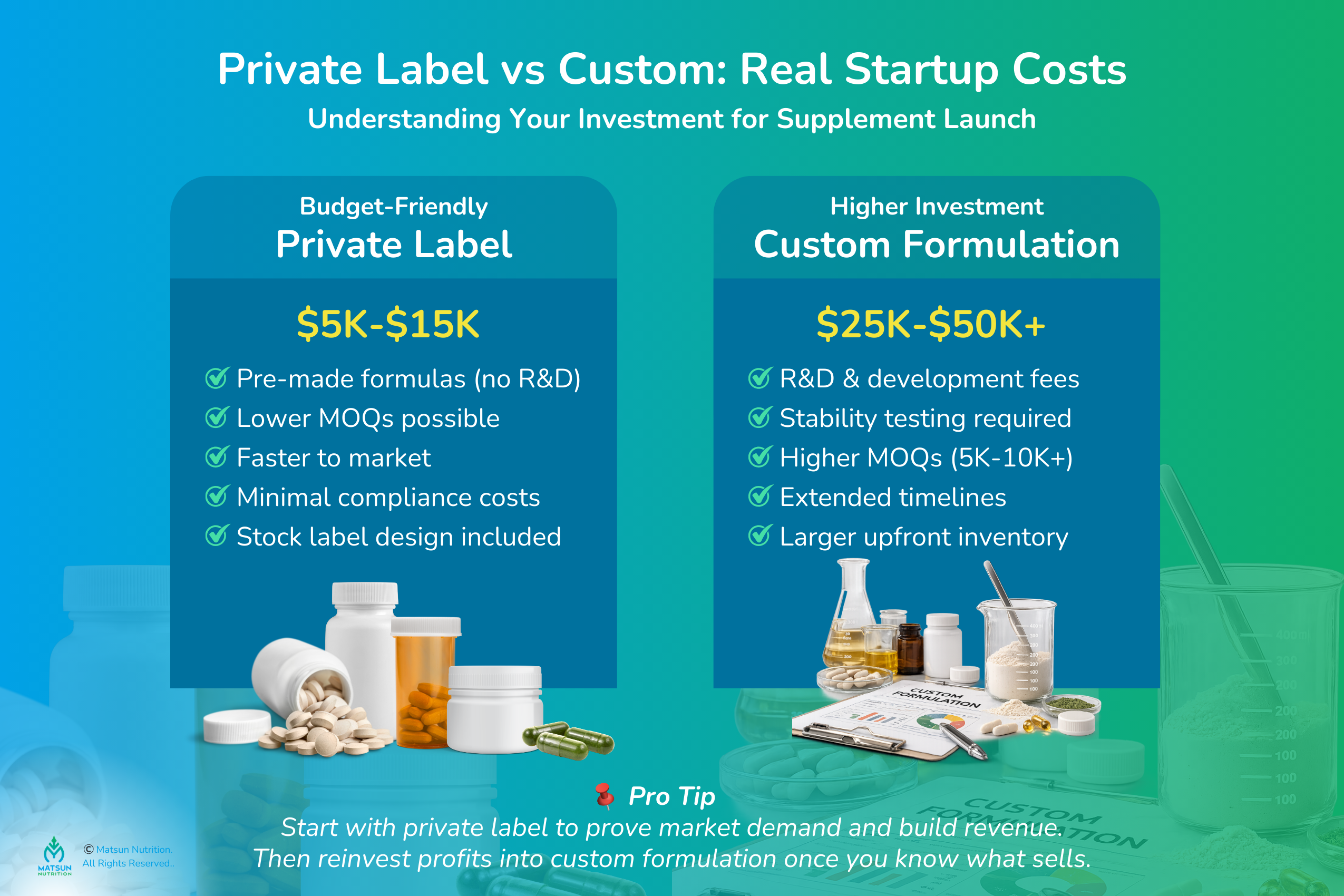
Private label health supplements come in at the lower end of that range because you’re not paying for custom research and development. Instead, you’re picking from proven formulas that a manufacturer has already developed, tested, and optimized. That alone can save you tens of thousands of dollars compared to building something from scratch.
Understanding these numbers upfront prevents sticker shock and helps you allocate your budget to the areas that actually move the needle, like branding, marketing, and getting your first customers.
Why Low MOQs Are the Ultimate Budget Hack for Wellness Brands
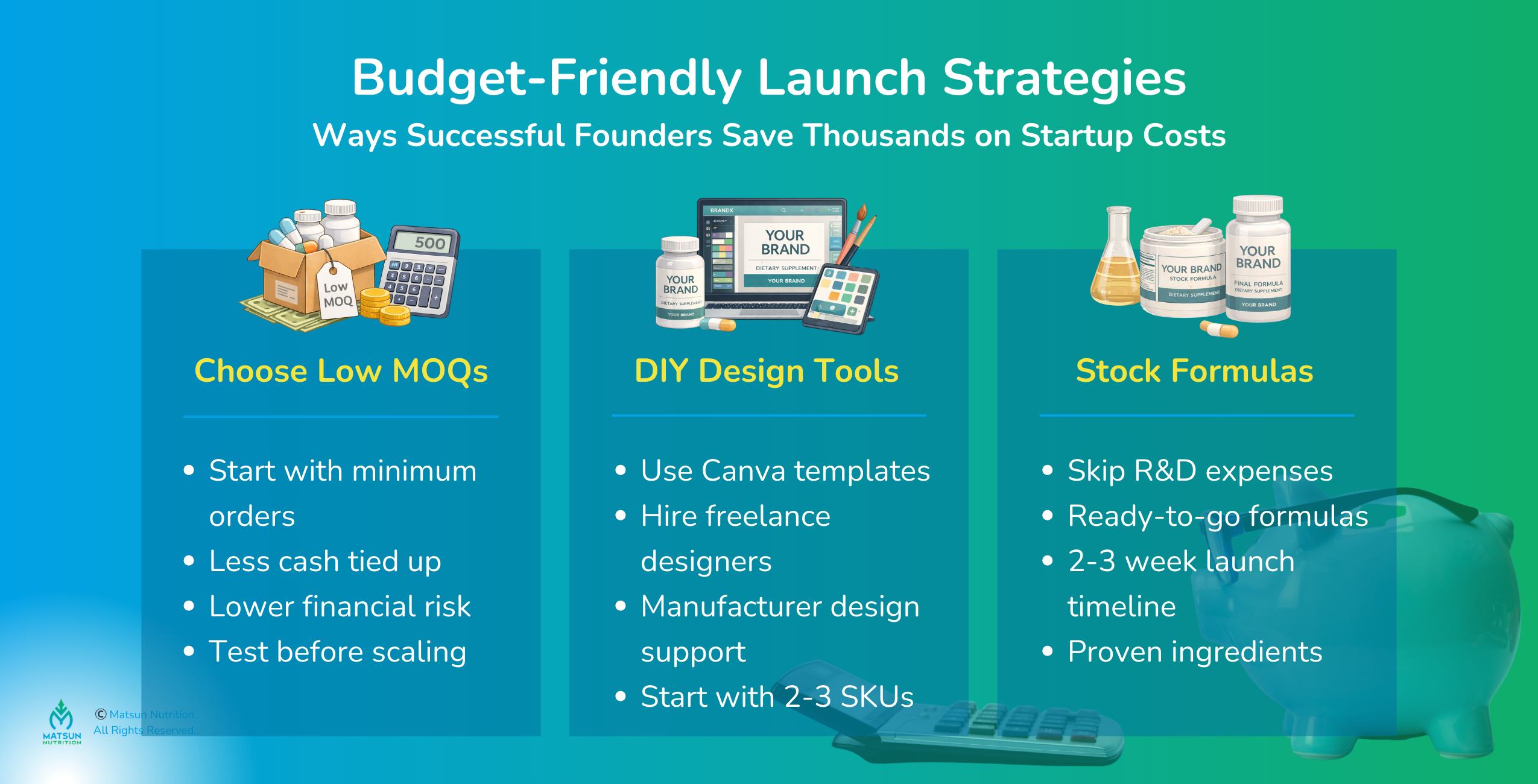
If there’s one factor that determines whether a small brand can get off the ground affordably, it’s the minimum order quantity. A low MOQ supplement manufacturer allows you to place smaller initial orders, which means less cash tied up in inventory and less financial risk if a product doesn’t sell as expected.
Some manufacturers require orders of 5,000 or even 10,000 units, which prices out most bootstrapped entrepreneurs. Others, including Matsun Nutrition, offer much lower minimums that make small batch supplement manufacturing practical for brands that are just getting started.
Working with a low MOQ partner lets you test your market, gather real customer feedback, and refine your product line before scaling up. It’s the difference between a calculated launch and a gamble.
Private Label vs. Custom: Which Path Fits Your Budget?
One of the first decisions you’ll face is whether to go private label or custom formulation. Understanding the private label vs. custom formulation cost difference is critical for budget planning.
With private labeling, you’re putting your brand on an existing, ready-to-go formula. With custom formulation, you’re paying a manufacturer to develop a unique product from the ground up. Custom work involves ingredient sourcing, stability testing, multiple rounds of sampling, and significantly higher minimums. For a single SKU, custom formulation can be expensive.
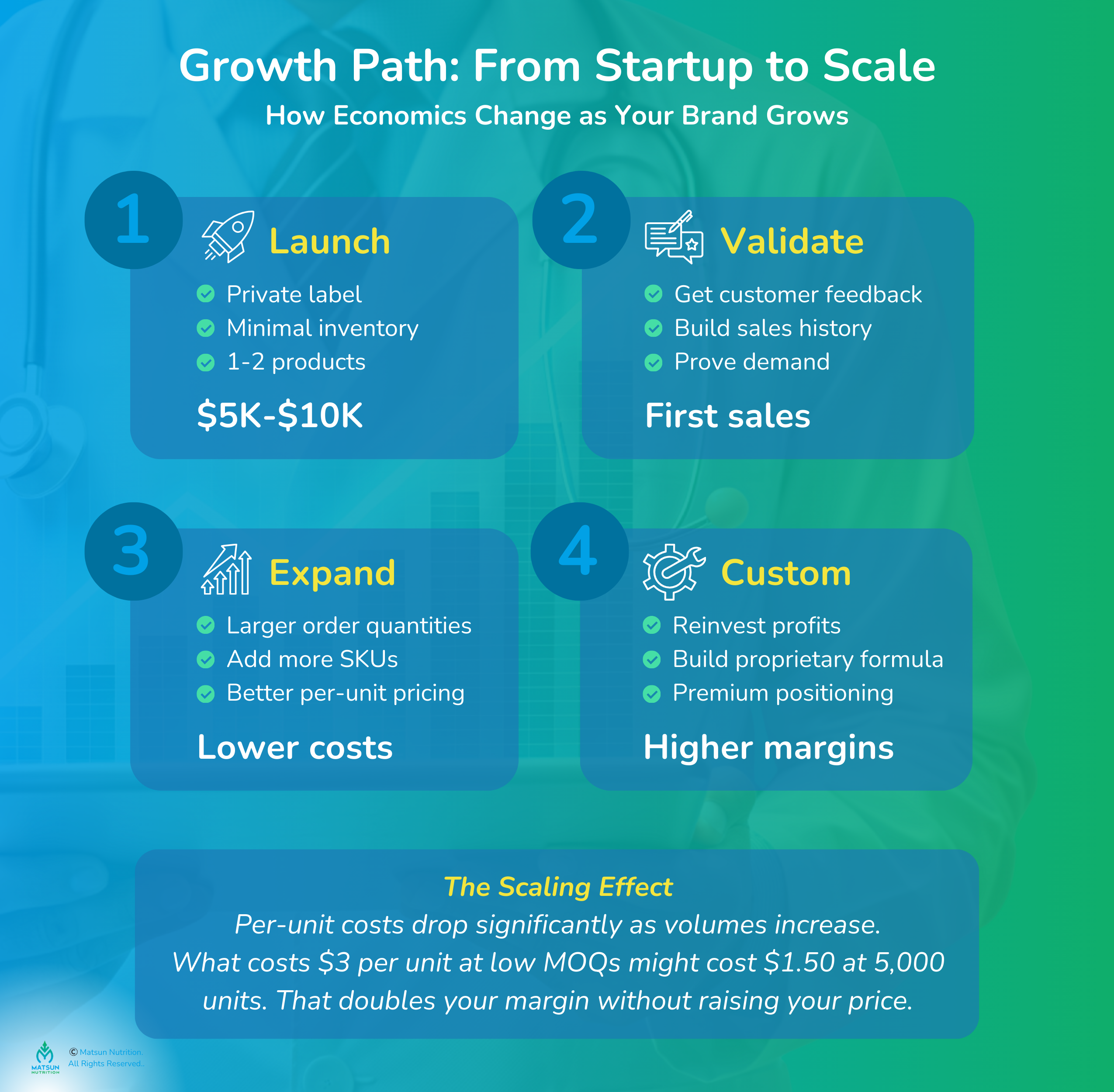
For founders watching their budget, affordable vitamin private labeling is the clear winner. You still get a high-quality product manufactured in a professional facility, but you skip the lengthy and expensive development phase. Many successful supplement brands started with private label products and only moved into custom formulation once they had steady revenue to reinvest.
Leveraging Stock Formulas to Eliminate Expensive R&D Fees
Stock supplement formulas are pre-made recipes that manufacturers keep on hand and ready to produce. These formulas have already gone through development, testing, and refinement, so you benefit from all that work without paying for it.
Choosing stock formulas is one of the fastest ways to achieve fast time-to-market supplements because there’s no waiting for formulation development or stability testing. You pick your product, choose your label design, and the manufacturer handles production. Some brands go from concept to finished product in as little as two to three weeks.
This approach is especially valuable if you want to launch multiple products at once. Instead of spending months developing each formula individually, you can select several stock supplement formulas and build out an entire product line from day one.
How to Save Thousands on Supplement Branding and Label Design
Your label is the first thing customers see, and it needs to look professional. But professional doesn’t have to mean expensive. There are several ways to keep branding costs low without sacrificing quality.
First, many private label health supplements manufacturers offer label design services as part of their packages. Matsun Nutrition, for example, provides design support that can save you the cost of hiring a separate graphic designer.
Second, tools like Canva and freelance platforms like Fiverr give you access to solid design work at a fraction of agency rates. For a budget-friendly health brand launch, you want clean, readable labels that clearly communicate your product’s value. You don’t need elaborate custom illustrations or premium foil printing when you’re just getting started.
Third, keep your SKU count small initially. Every new product means another label design, another round of revisions, and another set of compliance checks. Starting with two or three core products keeps your design costs manageable.
Managing Inventory Risk: Sizing Your Initial Buy Strategically
Nothing kills a new brand faster than sitting on thousands of units that aren’t moving. Smart inventory risk management for startups means ordering conservatively on your first run and scaling based on actual demand.
Start with the minimum order your manufacturer allows. Sell through that inventory, learn what your customers respond to, and then place a larger order with confidence. This approach keeps your cash flow healthy and prevents you from getting stuck with products that need reformulation or rebranding.
If you’re testing multiple products, spread your budget across smaller quantities of each rather than going all-in on a single SKU. This gives you real market data on what sells before you commit to larger production runs.
The Hidden ROI of USA-Based Manufacturing for Small Brands
It might seem counterintuitive, but choosing USA-made dietary supplements can actually save you money in the long run. Domestic manufacturing eliminates international shipping delays, reduces the risk of customs holds, and makes quality control dramatically easier.
When you work with a GMP certified facility, you also get built-in credibility with your customers. GMP (Good Manufacturing Practice) certification means the facility meets FDA standards for supplement production, which is something today’s health-conscious consumers actively look for.
The GMP certified facility advantages go beyond marketing, too. These facilities maintain consistent quality controls, proper documentation, and batch testing procedures that protect your brand from costly recalls or compliance issues down the road.
Choosing Your Niche: High-Demand Categories for 2026
Picking the right product category can make or break your launch. You want a niche with strong consumer demand and room for new brands to compete.
Liquid vitamin manufacturing trends in 2026 point to continued growth in liquid supplements across categories like multivitamins, immune support, and beauty-from-within formulas. Consumers increasingly prefer liquid formats for better absorption and easier dosing, making this a smart category for new brands.
White label nutraceuticals in the pet supplement space are also booming. Pet supplements represent a rapidly growing market where brand loyalty is still being established, which creates real opportunity for newcomers.
Clean label supplement sourcing is another trend worth paying attention to. Products with transparent ingredient lists, no artificial fillers, and recognizable ingredients command premium pricing and attract loyal customers who are willing to pay more for quality.
Compliance on a Budget: Navigating FDA and GMP Requirements
Regulatory compliance sounds intimidating, and it’s one area where cutting corners can cost you everything. But managing supplement label compliance costs doesn’t have to be prohibitively expensive if you approach it strategically.
Working with an experienced contract manufacturer is the single best way to reduce compliance headaches. Established manufacturers already understand FDA labeling requirements, Supplement Facts panel formatting, and the specific claims you can and cannot make on your packaging.
This expertise is baked into their service, so you’re not paying a separate regulatory consultant thousands of dollars to review your labels. Your manufacturer’s compliance team catches issues before they become expensive problems.
Keep your marketing claims conservative and factual. Structure/function claims are permitted without FDA pre-approval, but they need to be truthful and substantiated. Staying within these boundaries from the start saves you from costly label reprints or, worse, FDA warning letters.
Scaling Your Brand: Moving from Small Batches to Large Production
Once your initial products are selling consistently, the economics of scaling work heavily in your favor. Per-unit costs drop significantly as order volumes increase, and you’ll have the customer data and revenue to justify larger investments.
The transition from small batch supplement manufacturing to full-scale production is where working with the right manufacturing partner really pays off. A wholesale supplements partner that handles both small and large runs means you don’t have to switch manufacturers as you grow. You keep the same quality, the same relationships, and the same institutional knowledge about your products.
As you scale, you can also start exploring custom formulation for your best-selling products. By this point, you’ll know exactly what your customers want, which makes custom development a smart investment rather than an expensive guess.
Ready to Launch Your Supplement Brand Without Breaking the Bank?
Starting a private label health supplements brand on a budget is entirely achievable when you partner with the right manufacturer. Matsun Nutrition offers low minimum order quantities, stock formulas across dozens of categories, in-house label design support, and GMP-certified production, all right here in the USA. Whether you’re launching your first product or expanding an existing line, get in touch with Matsun Nutrition to see how affordable it can be to bring your brand to life.
FAQs
What is the minimum cost to start a supplement brand?
Most private label supplement brands can launch for between $2,000 and $10,000, depending on product type, order quantity, and how much branding work is done in-house versus outsourced.
Does private labeling save money on R&D?
Yes. Private labeling uses pre-existing stock formulas, so you skip the formulation development, stability testing, and sampling costs that come with custom manufacturing.
What is a low MOQ for health supplements?
A low MOQ typically ranges from 100 to 500 units, depending on the manufacturer and product type. This allows startups to test products without a massive upfront investment.
How can I save on supplement label design?
Work with a manufacturer that includes design services, use affordable tools like Canva, or hire freelancers on platforms like Fiverr. Keep your initial SKU count low to minimize total design costs.
Is private label cheaper than custom manufacturing?
In almost every case, yes. Private label eliminates R&D fees, reduces minimums, and shortens your timeline, all of which translate to significant cost savings for new brands.
How long does it take to launch on a budget?
With stock formulas and a responsive manufacturer, you can go from concept to finished product in as little as two to four weeks.
Are budget supplements still high quality?
Absolutely. Budget-friendly private label supplements from GMP-certified facilities meet the same quality and safety standards as premium custom products. The savings come from shared formulas and efficient production, not reduced quality.
Can I test multiple products with a small budget?
Yes. Low MOQ manufacturers let you order small quantities across several products so you can test market demand before committing to larger production runs.